
Important Disclaimer
First of all, I want to make it clear that what you are about to read is simply my opinion and my personal experience. With that out of the way, come along with me through the story of how I ended up using Linux as my main operating system. 🐧
How I Got Started with Linux
Everything started during my fourth semester at university. Up to that point, my experience had been limited to Windows, but a quick look at a classmate’s lock screen running OpenSuse with KDE Plasma sparked my curiosity. It felt completely different from what I knew, and I wanted to understand what was behind that system.
I decided to dive into that world and installed my first Linux distribution: Manjaro. The experience was exciting. Discovering a new desktop environment and starting to use the terminal marked the real beginning of my Linux journey.
As usually happens when you are just getting started, not everything went well. Manjaro gave me problems that, as a beginner, I did not know how to solve, even while following tutorials, so I decided to switch to Fedora.
Fedora stayed with me for about six months and got me used to a constant pace of updates. At the time, I did not even fully understand concepts like “rolling release”; I simply assumed that was the normal experience. The problem came when my laptop stopped booting, and that forced me to look for another alternative. That is how I ended up on OpenSuse.
The move to OpenSuse was important in terms of stability. I liked how solid it felt, but as a beginner I also ran into a level of complexity that was sometimes frustrating.
My path through Linux was not just a sequence of installs and distro changes; it was also a stage of constant learning, trial and error, and a lot of curiosity. Despite the problems, Linux’s flexibility and possibilities kept me exploring.
Why Didn’t I Start with Ubuntu?
In short, I did not start with Ubuntu because of prejudice. When I first entered the Linux world, I kept hearing comments saying Ubuntu was “for beginners,” that it was “orange Windows,” or that people who used it did not really know Linux. At the time, I let those opinions influence me a lot and, to be honest, I was also afraid of becoming the target of jokes among classmates.

My Beginning with Ubuntu
To explain how I ended up on Ubuntu, I first need to mention that my first desktop environment on Linux was KDE Plasma. I had grown quite used to it, so I looked for something similar based on Ubuntu and chose KDE Neon.
Technically, I was already using Ubuntu as a base, although through a different distribution. For anyone unfamiliar with it, KDE Neon is the distribution maintained by the KDE Plasma project. Even so, I still had the problem of frequent updates, and that was not convenient for the projects I was working on at the time.
Eventually, putting those prejudices aside, I decided to try Ubuntu 22.04 on my new Lenovo ThinkPad T14. The installation was surprisingly simple and, to my surprise, almost everything worked from the beginning without extra configuration. Even the fingerprint reader was ready to use.
Why Should You Use Linux?
I strongly believe that curiosity is one of the most valuable things we have. Throughout history, that curiosity has pushed us to discover, build, and question what we take for granted. The same applies when we talk about operating systems.
I have nothing against Windows. Every operating system has advantages and disadvantages. But many of us grow up thinking Windows is practically the only real option, and that makes us not even consider exploring something different.
Linux opens the door to a different approach. It pushes you to learn, experiment, and develop your own judgment to choose the tool that best fits the way you work. Even if you decide not to stay with Linux in the end, simply trying it already teaches you a lot.
My Current Situation
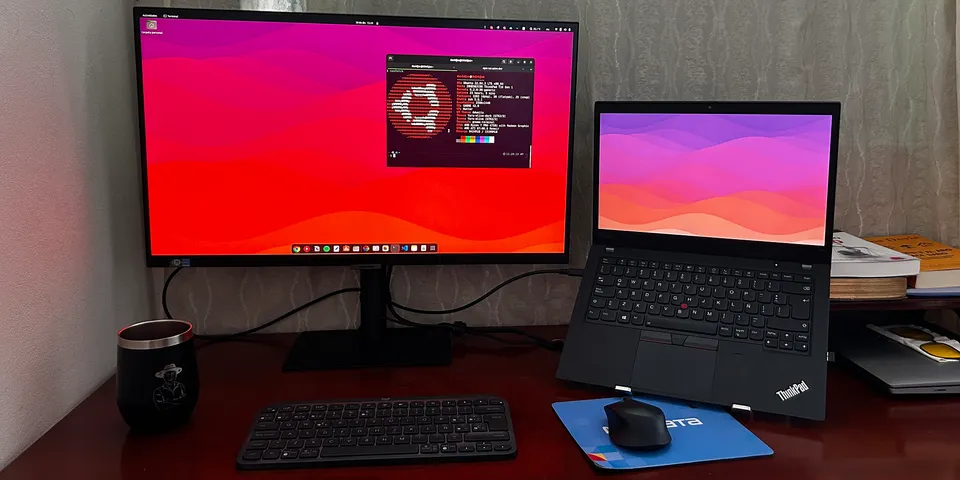
Right now I have two laptops: one provided by my company for work inside a Windows-based ecosystem because of corporate requirements, and another personal one that I use for my own projects, like this blog, where I run Ubuntu 22.04 as my main operating system.
Ubuntu has given me exactly what I needed: stability, a comfortable development environment, and less worry about constant updates or unexpected issues. In short, it lets me focus more on working and less on fighting with the system.
Maybe in the future I will switch to another distribution, I do not know yet. But what I do know is that, for now, Ubuntu is the operating system that best fits my needs.
Final Thoughts
I encourage you not to ignore your curiosity. You do not have to become a fan of an operating system to explore something new. If Linux seems interesting to you but also a little intimidating, Ubuntu still feels to me like one of the best entry points.
I am not writing this to defend one system over another at all costs. I simply feel that Linux, and Ubuntu in particular, fits my needs as a developer really well. And just as I enjoy using Ubuntu today, I am also interested in trying other options in the future, like macOS, to better understand how people work in other environments.
If this article managed to spark even a little curiosity in you, then it already achieved its goal. Thanks for reading. 👋